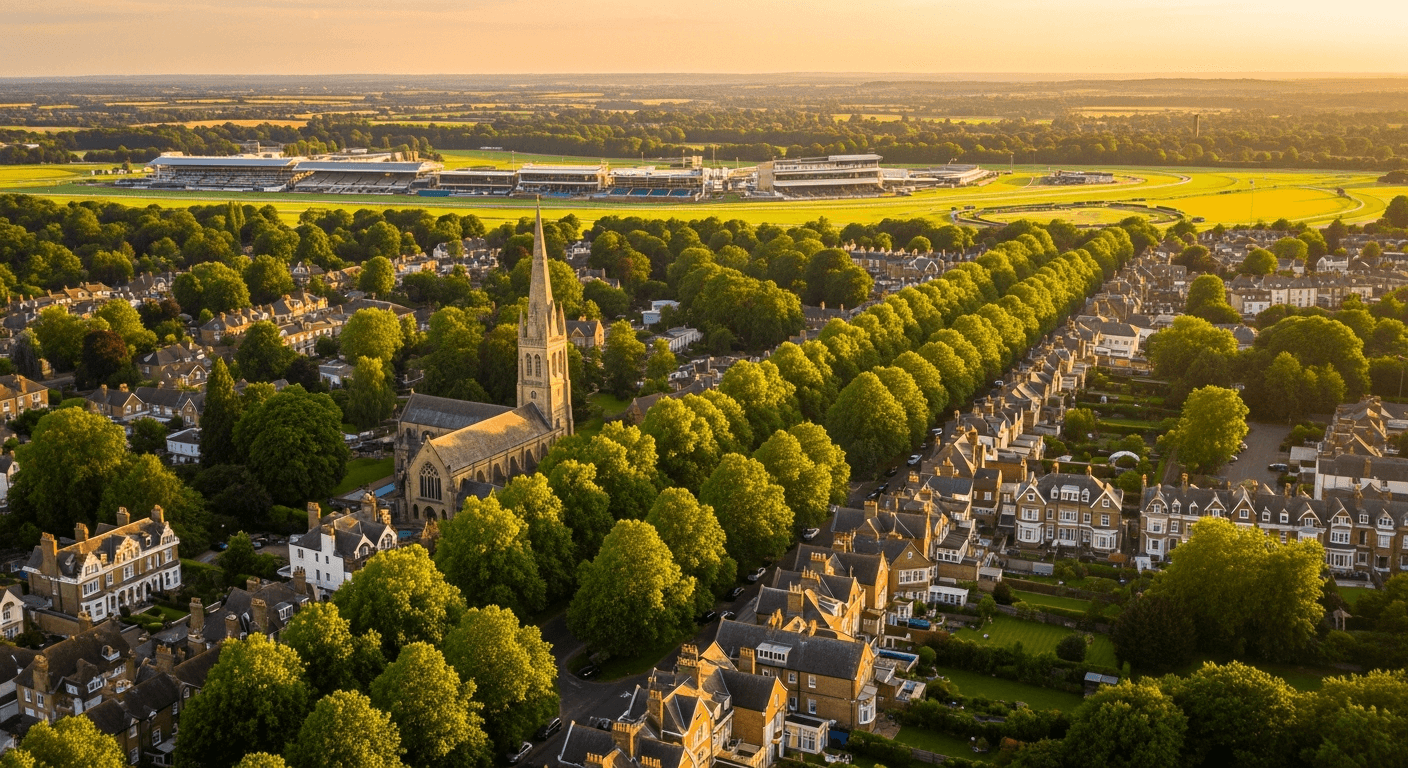
15 Interesting Facts About Gosforth
From the meaning of its name to a 2,000-acre estate, a railway workers' village, and Europe's largest fair, here are 15 things you might not know about Gosforth.
Think you know Gosforth? Even long-time residents are often surprised by some of the history, quirks, and facts hidden in the streets around them. Here are 15 things you might not know about this corner of Newcastle.
1. The name means "Goose Ford"
The name Gosforth comes from the Old English gos forð, meaning "goose ford" — a crossing point where geese gathered, probably over the River Ouse (now the Ouseburn). The name was first recorded as Goseford in 1166. An alternative theory suggests it means "Ouse Ford," referring to the river itself.
2. It wasn't always part of Newcastle
Gosforth was a separate Urban District of Northumberland from 1895 until 1974, when it was merged into the City of Newcastle upon Tyne as part of local government reorganisation. Some older residents still remember it as an independent community.
3. The High Street started as a vote-buying scheme
Gosforth's modern centre on the High Street began life as Bulman Village, built in 1826 on land given by Job James Bulman to provide voters to support him in a local election. The street that grew from it is now one of the most popular independent high streets in the North East.
4. The Brandling family owned 2,000 acres
The Brandling family owned the Gosforth Park estate — around 2,000 acres — from about 1509. Gosforth House was built between 1755 and 1764, designed by architect James Paine, with a 50-acre lake laid out in the grounds. The family's name lives on in the Brandling Arms and Brandling Villa pubs.
5. The Town Moor is bigger than Hyde Park and Central Park
The Town Moor covers around 1,000 acres — larger than London's Hyde Park and Hampstead Heath combined, and bigger than New York's Central Park (843 acres). It's one of the largest areas of common land in any English city.
6. Cattle still graze on ancient rights
Freemen of Newcastle have held the right to graze cattle on the Town Moor since the 12th century. Unlike many historic common rights elsewhere, these aren't ceremonial — real cattle graze the Moor from April to October every year, and the rights ensure the land can never be built on.
7. The Hoppings started as a temperance fair
The Hoppings, held on the Town Moor each June, is one of Europe's largest travelling fairs, attracting around 300,000 visitors over nine days. It began in 1882 as a Temperance Fair — an irony not lost on anyone who's seen the queues for the beer tent. It continues a tradition of fairs on the Moor dating back to the Lammas Fair in 1218.
8. The racecourse has been here since 1882
The Northumberland Plate — known as "The Pitmen's Derby" — moved to Gosforth Park in 1882, establishing the site as the home of Tyneside horse racing. Newcastle Racecourse now hosts around 70 fixtures a year and is one of the premier flat racing venues in northern England.
9. Gosforth had coal mines
Before the tree-lined avenues, Gosforth was coal country. Coxlodge Colliery comprised three pits: the Bower Pit, the Regent or Engine Pit (where Regent Centre now stands), and the Jubilee or North Pit on Jubilee Road. The landscape today gives little hint of the industrial past beneath it.
10. Garden Village was built for railwaymen
Gosforth Garden Village was laid out in the early 1920s by the North Eastern Railway Company to house workers at the adjacent railway yards (now the Tyne & Wear Metro depot). The NER bought 64 acres in 1921 and built 266 houses by 1928 on "garden suburb" lines. The community remains distinctive, with the residents' association still active today.
11. All Saints Church is over 850 years old
All Saints Church on Church Road was founded in the 1170s and is a Grade I listed building — the highest heritage protection level. Its churchyard contains some of the oldest surviving structures in Gosforth. The church has been at the heart of the community for over eight and a half centuries.
12. Northern RFC is Newcastle's oldest rugby club
Northern Rugby Football Club at McCracken Park was founded in 1875 as Elswick Football Club, making it the oldest rugby club in Newcastle. The first player capped directly from the club was England half-back Mason Scott in 1890. Northern's president William Cail went on to become president of the RFU in 1892.
13. The nature reserve dates back to 1924
Gosforth Park Nature Reserve was established in 1924 as the Gosforth Park Bird Sanctuary by William Edward Beck. Managed by the Natural History Society of Northumbria since 1929, it's the oldest nature reserve in North East England — ancient woodland, wetland, and a lake, hidden within High Gosforth Park.
14. Alan Shearer, Mark Knopfler, and Neil Tennant all grew up here
Gosforth has produced a remarkable number of famous names. Alan Shearer (Premier League all-time record scorer) was born here. Mark Knopfler (Dire Straits) grew up on Briarfield Road. Neil Tennant (Pet Shop Boys) grew up in Brunton Park. Shearer and Knopfler both attended Gosforth High School (now Gosforth Academy). See our full guide to famous people from Gosforth.
15. South Gosforth featured in a medieval military retreat
South Gosforth makes an early historical appearance in 1319, when the English army retreated there during a siege on Berwick-upon-Tweed. Not the most glamorous debut — but it puts the area's history firmly into the medieval period, long before the Victorian villas and Metro stations arrived.
Know another surprising fact about Gosforth? Get in touch via our contact page.